The Sovereign Bet
Key takeaways
- 1Renting frontier AI no longer sets any organization apart, and it leaves core operations exposed to pricing, access and policy decisions made by others. Private AI protects data but doesn’t solve that dependency.
- 2Owning AI has become affordable and compounds over time. The cost of running capable AI has fallen sharply, and models trained on an organization’s own data and corrections become an advantage competitors can’t buy
- 3The shift is happening gradually, with the frontier kept for the hardest problems. Owning the control plane tends to be the turning point, because it makes every model replaceable and keeps the learning inside the organization
Why Owning Your AI Is the Next Strategic Advantage
The Bottom Line
Frontier models are the most important technology of the decade, and they are not your strategy. Every competitor can rent the same intelligence by API tomorrow. The durable advantage lies in AI you own, running on your infrastructure, trained on your data and governed by your rules.
They remain essential. The risk lies in depending on them. The economics now allow an alternative. The cost of running capable AI fell more than 280-fold in two years, and frontier-level performance reaches consumer hardware within about eight months. Over the next five years, the enterprises that pull ahead will run AI locally by default and use the frontier by choice.
The case rests on three points. Renting AI no longer sets anyone apart, and it leaves organizations exposed to decisions made by others. Owning AI has become affordable, and its value compounds with use. Organizations are already making the move, keeping the frontier for the problems that need it most.
Part One: Why Renting Falls Short
The frontier is a utility, not a strategy
When every company rents the same model, the model stops being an advantage. It becomes like electricity or cloud storage, essential and steadily improving, but identical for you and your competitors.
The first phase of enterprise AI was about access. Leaders raced to get licenses, run pilots and integrate the leading models. That race is effectively over. Access to frontier capability is now a commodity available to anyone with a credit card.
The frontier itself is converging. Stanford's 2026 AI Index found that as of March 2026, the top models from four companies sat within 25 Elo points of one another on the Arena leaderboard, shifting competition toward cost, reliability and domain-specific performance.
Renting a commodity carries costs that rarely show up in a pilot. Prompts and integrations are easy to copy, and the intelligence underneath is the same one your competitors use. The infrastructure behind it is concentrated too, with Epoch AI estimating that five hyperscalers own 71% of global AI compute.
Pricing that looks trivial at pilot scale becomes a serious line item once AI runs everywhere, and the vendor sets that price. Google's published API pricing shows its current Flash models doubling in price on January 1, 2027. The same page notes an image model that was shut down on October 2, 2026, with customers told to migrate.
Access itself can change, too. In June 2026, some frontier models were temporarily withdrawn to comply with U.S. export controls, and restored a few weeks later. Customers had no say in it.
None of this makes frontier models less valuable. It just makes them a poor place to anchor a strategy, because you can't build an advantage on the thing everyone else also has.
The privacy trap
Many enterprises believe they have contained AI risk because they have secured their data. They have solved about half the problem. Privacy protects your data; sovereignty protects your business.
Private AI is about who can see your data. Its tools are familiar by now, including encryption, private endpoints, no-training clauses and confidential computing. It fails when data leaks or gets misused. In the terms of the dependency ledger described below, it passes the visibility test.
Sovereign AI asks something harder. Who can switch your capability off, change it or set its terms? The answers involve owned models, owned infrastructure, a control plane you run yourself to route work between models, and a credible way out of any contract. It fails when a vendor changes a model, raises prices or withdraws access, or when a regulator steps in.
The two come apart easily. A frontier model in a dedicated, encrypted environment is private, but the vendor can still change it, reprice it or withdraw it. A state-run national platform can be the reverse, sovereign but hardly private.
That is the trap. Years of privacy investment, including enterprise agreements, private endpoints and data-residency commitments, have created a sense of security that masks dependency. When a board hears "our AI is private," it hears "our AI is safe." Those are not the same claim.
The platform trap
Even perfect data privacy leaves another exposure. Most paid enterprise agreements commit providers not to train on customer content, and that commitment matters. But a provider can learn a great deal about a business without ever training on its data.
The first route is the side door. Free and consumer tiers often do use content to improve products, as Google's own pricing page states plainly. Employees bring such tools to work, too. Microsoft and LinkedIn's 2024 Work Trend Index found that 78% of AI users were bringing their own AI tools to work. Business knowledge can leave the building even when the official contract is airtight.
The second route is the view from the platform. A provider serving thousands of organizations can see which tasks, workflows and industries drive usage, and that shows it where value lies and where to build next.
The third route is the move up the stack. Frontier providers increasingly offer agents and finished applications, not just models. An organization that runs its core workflows on a provider's platform may be showing a future competitor what its work looks like. Other platforms have taught this lesson before. A supplier that learns your business can become your competitor.
Sovereignty closes that gap in a way privacy cannot. When the workflows, the data and the improvements that build up with use run on infrastructure the organization owns, nobody else learns from them.
Part Two: Why Owning Now Pays
Why sovereign is the big bet
Sovereign AI turns AI from an expense you rent into an asset you own, and assets compound.
The compounding starts with the learning loop. Every interaction with an owned model can make it better, whether it's a correction from an underwriter, the outcome of a claim or a judgment call from a senior engineer. Over time that becomes institutional knowledge encoded in software. With a rented model, improvements flow into the vendor's next release, available to everyone.
Data is the other half. It is the one AI input that cannot be replicated. Even when contracts bar vendors from training on it, data that only informs a rented model never becomes capability you own.
Owned AI also gets cheaper with each hardware refresh, while the bill for rented AI grows with every new use. It keeps working if external access disappears. It sits under your own controls, auditable end to end, rather than under a vendor's terms. Because nobody else has it, it is the only kind of AI that can set you apart.
The economics have flipped
Until recently, sovereign AI meant a megaproject, with data centers, scarce chips and power contracts that only governments and hyperscalers could fund. Epoch AI puts the up-front cost of a typical one-gigawatt AI data center at roughly $38 billion. That is no longer the only path. The cost of running capable AI is collapsing far faster than the cost of building frontier models.
Stanford's 2025 AI Index found that the cost of running a system at GPT-3.5's level fell more than 280-fold between November 2022 and October 2024, driven largely by more capable small models. Open models have stayed close behind the frontier since. The 2026 edition puts the top closed model just 3.3% ahead of the top open model as of March 2026, a narrow margin. Epoch AI also finds that frontier-level performance becomes runnable on consumer hardware within about eight months.
Smaller models trained to imitate larger ones, compression that fits models into ordinary memory, and AI accelerators built into standard hardware now put most enterprise workloads within reach of infrastructure organizations already own or can readily buy. For drafting, summarizing, document search, coding assistance and classification, small open-weight models are already good enough. High-volume workloads still need dedicated servers, along with the power, cooling and skills to run them. That is a real cost, but an ordinary capital decision, measured in servers rather than gigawatts.
The closest precedent is energy. Rooftop solar did not abolish the grid, but it turned energy independence from a utility's megaproject into an ordinary capital purchase. AI is following the same path. Sovereignty becomes a line item in a hardware refresh.
The operating model is already in place. Enterprises manage thousands of endpoints, servers, identities and audit logs every day. Running a model on that estate is simply another workload. After fifteen years of moving computing outward to the cloud, AI is the first strong reason to bring critical capability back inside.
The decision therefore changes shape. The question stops being whether an organization can afford sovereign AI and becomes which workloads deserve it.
A few traits tend to tip the balance toward owning. Volume is the first, since the savings grow with every request. Repeatability is the second, because a smaller model can learn a stable task well. Sensitivity and criticality complete the picture. Data that must stay inside, and work that must keep running whatever a vendor decides, both belong on owned infrastructure.
Renting still fits work that is occasional, experimental or at the edge of difficulty. There, the frontier's lead matters, and volume is too low to justify building. Most organizations will find their portfolio spread across both, with the balance moving toward owning as each task matures.
The dependency ledger
Deciding which workloads deserve sovereignty starts with knowing where dependency already sits. Every AI capability the business relies on should pass three tests. A capability that fails all three is a critical dependency and belongs on the enterprise risk register, alongside supply chain and cyber risk.
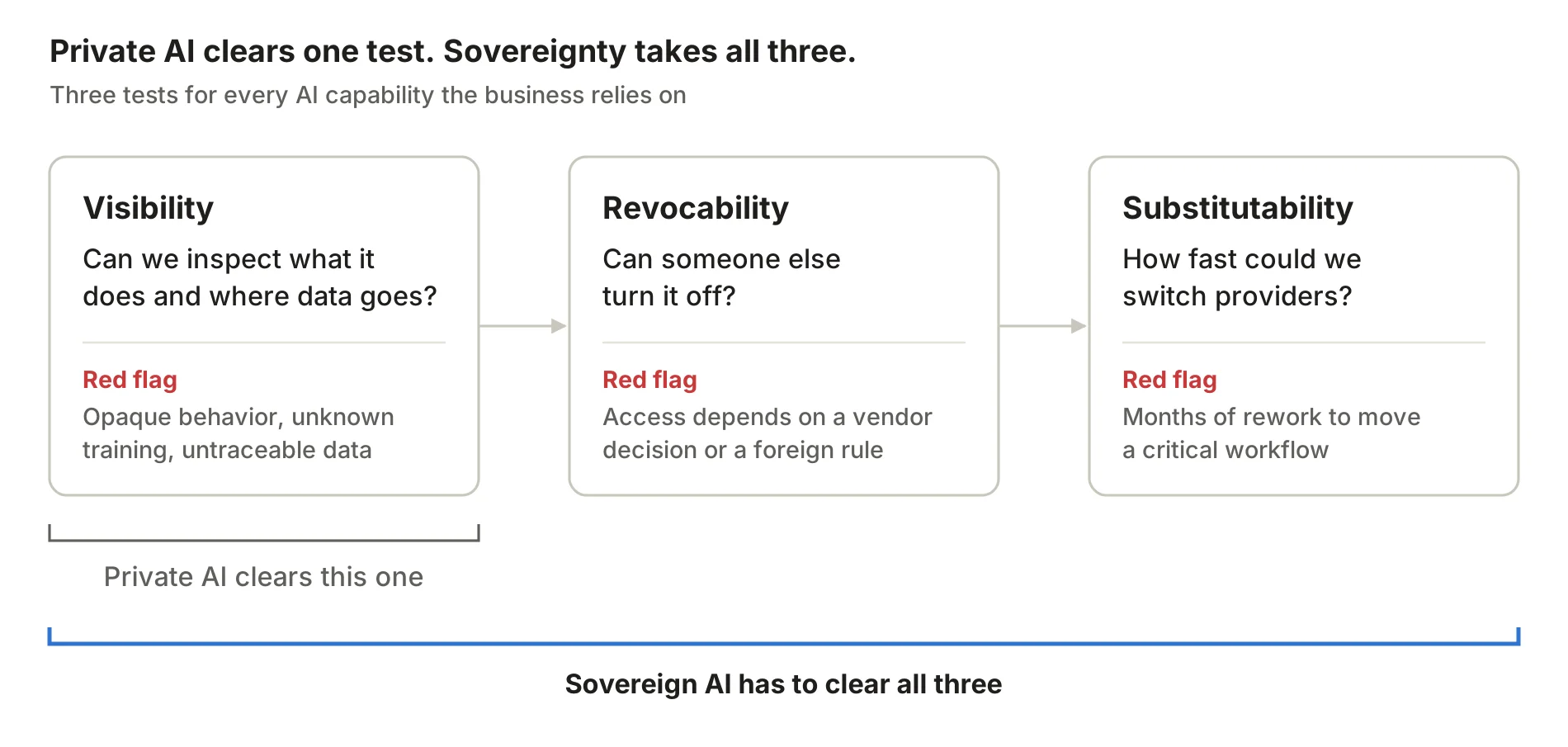
Many private AI programs pass the visibility test and stop there. Revocability and substitutability are where sovereignty is won or lost, and they are where the harder work lies.
Model weights make the three tests concrete. Weights are the model itself, the learned parameters that make it work. Frontier providers don't release theirs, so their models can only be reached through the vendor's service. An organization can't inspect them, host them, freeze a version it trusts or keep running one the vendor retires. By design, closed weights fail all three tests.
Open-weight models change that. Once a copy runs on an organization's own infrastructure, nobody can take it back, and it can be tested, adapted and swapped like any other asset. At the frontier, the trend runs the other way. Stanford's 2026 AI Index reports that foundation model transparency declined in 2025, after improving the year before.
Applied honestly, many enterprises are likely to find their most valuable AI workflows fail at least two tests. That is the finding that should move the board, because it means the organization is quietly building core operations on capabilities it neither controls nor can replace quickly.
That also reframes maturity. The goal is to move each critical capability from dependent to hedged, then to resilient, and finally to sovereign, without trying to own everything.
Part Three: How the Shift Is Happening
How the shift is unfolding
Organizations moving away from frontier dependence are rarely doing it in one migration. The pattern looks more like a gradual portfolio shift, toward an end state where AI runs locally by default and the frontier is used by choice.
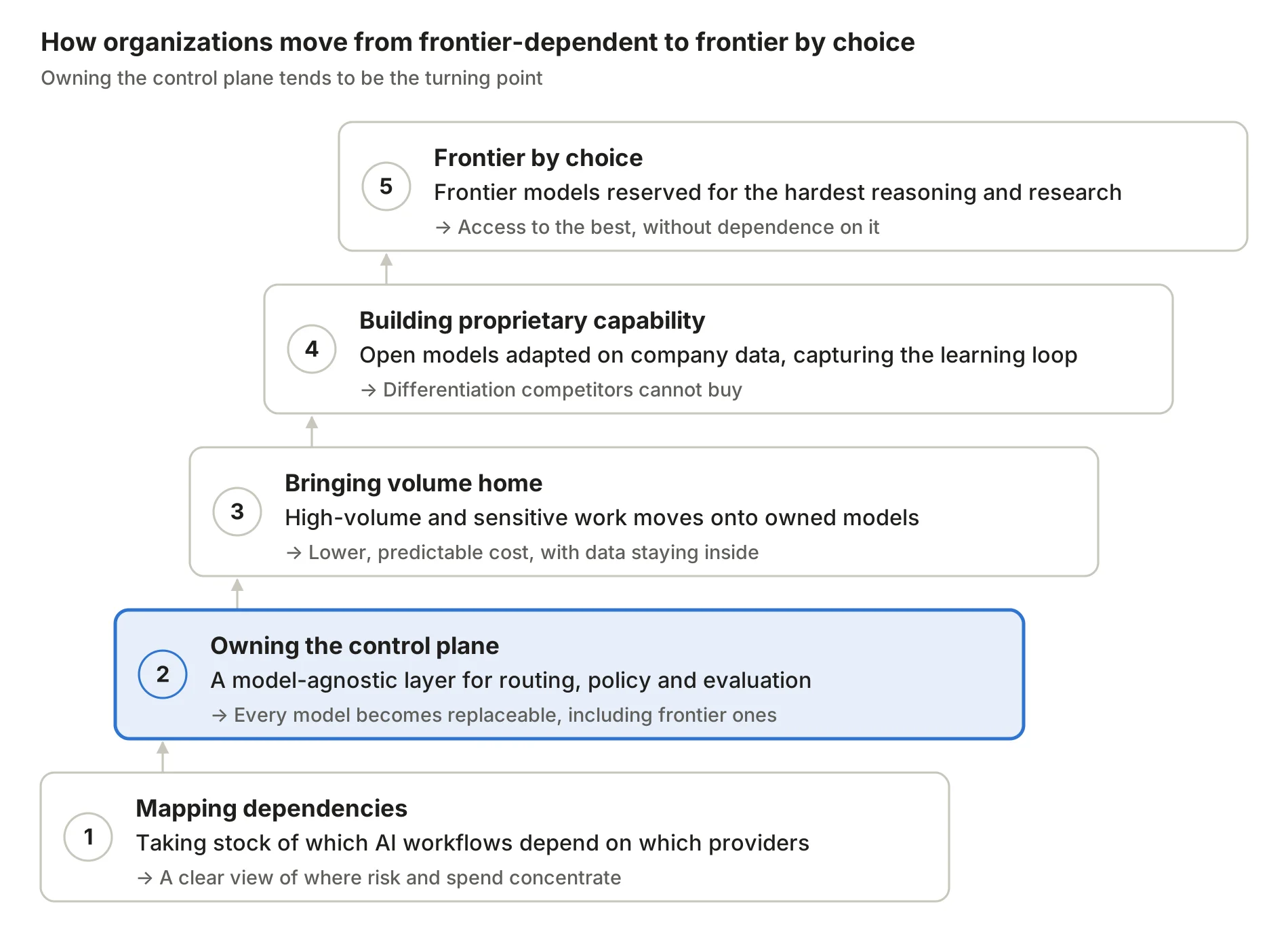
The second stage tends to be the turning point. The control plane is the software layer that sits between an organization's applications and the models they use. It decides which model handles each task, applies the organization's policies, records what happens and checks the quality of the results. Once an organization owns that layer, every model behind it becomes replaceable, whether it runs locally or in a vendor's cloud, and the balance of negotiating power shifts with it.
The control plane is also where much of the learning loop lives. The corrections, outcomes and context that make AI better over time pass through it, so whoever owns it keeps that knowledge.
The fourth stage is where the frontier plays its most strategic role. For well-defined, repeatable work, such as classifying claims, extracting contract terms or answering questions about internal policy, a frontier model can generate high-quality examples of the task done well. A smaller model trained on those examples, along with company data and expert corrections, can then take over that work on owned infrastructure, at a fraction of the cost. The frontier does the hard thinking once, and the owned model does the routine work from then on.
Used this way, the frontier becomes the teacher that makes an organization less dependent on it. It stays useful afterward too, for checking the owned model's work and handling cases it hasn't learned yet.
This route has limits of its own. Many providers' terms restrict using their outputs to train other models, and those terms vary and change. Open-weight models make cleaner teachers, though their licenses carry conditions too. Even the path to independence can be governed by someone else's rules, which is exactly why the question of control matters.
The frontier stays in the picture throughout. What changes is its role, from a foundation an organization can't leave to a supplier, and sometimes a teacher, that it chooses.
What stays hard
A credible sovereign strategy names its limits before the board does.
The frontier keeps moving, so owned models catch up to where it was rather than where it is. For the hardest problems, rented capability is likely to stay ahead, but the share of work that needs it keeps shrinking, as each new level of capability reaches owned hardware within months. Matching the frontier at its origin is only getting harder, with Epoch AI estimating that frontier training costs have grown about 3.5 times a year since 2020.
At the very top, the most advanced capability may not be rentable at all. In April 2026, Anthropic chose not to release its most capable model, Claude Mythos Preview, to the public, offering it instead to a small group of partner organizations through Project Glasswing. The company's stated reason was safety, since the model can find and exploit software vulnerabilities better than all but the most skilled humans. Access to its most advanced cybersecurity capabilities is now granted by application, in tiers.
That decision can reasonably be read two ways. It is a responsible way to handle a powerful and potentially dangerous capability. It is also a form of gating, in which the provider decides who gets access and on what terms. Both readings can be true at once, and for strategy, the second is the one that matters. If the pattern spreads, the leading edge becomes something an organization is granted rather than something it buys, which makes it a weak foundation to build on.
Hardware is the next limit. Owning it removes the remote off-switch, but the chip supply chain behind it is still highly concentrated. Stanford's 2026 AI Index notes that a single company, TSMC, fabricates almost every leading AI chip.
Owned models bring responsibilities of their own. Running an open model gives control over how it's used, but not over how it was trained, so its provenance deserves the scrutiny you'd give any critical supplier. They also behave less predictably than ordinary software. An update can shift their behavior without warning, so they need ongoing evaluation after every change.
Ownership also shifts work onto the organization. Running infrastructure draws on skills most IT teams already have, but evaluating models, adapting them on company data and training smaller models from larger ones call for specialized expertise that is still scarce. Owning and modifying models can also move some regulatory responsibilities from the vendor to the organization, depending on the jurisdiction and the use.
Finally, cheaper AI tends to mean more AI. As unit costs fall, usage grows, and total spend may not drop as fast as the business case assumes.
None of these argues for staying dependent. Together they explain why the right target is frontier by choice, not frontier never.
The Shift Underway
For the past few years, the advantage went to whoever adopted fastest. That advantage is fading. Frontier models matter as much as ever, but access to them no longer separates anyone.
Several shifts are taking its place. Value is moving from the model to everything around it, including the data, the workflows and the learning that accumulates with use. Risk is moving from data exposure to dependency, from who can see your information to who can switch off your capability. And the cost of control is moving from a national megaproject to an ordinary decision about infrastructure most organizations already run.
None of these shifts means abandoning the frontier. They change its role. The most capable models become something an organization reaches for deliberately, for the problems that need them most, rather than the foundation everything else rests on.
The sovereignty debate is ultimately less about technology than about ownership. In the years ahead, what will separate organizations is less the model they use than the intelligence they can call their own. That is the sovereign bet.
Sources
- Stanford HAI, AI Index Report 2025 and AI Index Report 2026
- Epoch AI, Trends in AI (epoch.ai/trends), accessed November 2026
- Microsoft and LinkedIn, 2024 Work Trend Index, May 2024
- Anthropic, statement on the US government directive to suspend access to Fable 5 and Mythos 5, June 12, 2026, and Project Glasswing (anthropic.com/glasswing)
- Google, Gemini Developer API pricing, accessed November 2026
- sovereign ai
- harness matters